
People come to me with the same question, over and over. Different words, same core: "Is there a grant specifically for real estate?"
The short answer will disappoint you. But there is more beyond it than it seems at first. And at the end — free support from me, personally.
Let''s start with what actually hides behind the word "real estate," because it is not one request — it is at least seven different ones.
What "real estate" actually means here
Agricultural land. Expanding a field, acquiring land for greenhouses, for a new crop.
Land for construction. Finding a site for a workshop, a warehouse, a new building from scratch.
A ready commercial building. A shop, warehouse, workshop, office — already built, just needs to be bought or leased long-term with an option to buy.
A ready residential building. Rarer, but it happens — when part of a home is meant for a guest business or mixed use.
Renovation and reconstruction of a commercial property. The space already exists, but it is not in the condition needed to operate or grow.
Renovation and reconstruction of residential property. Same idea, but for residential property that is also tied to a business.
Construction materials on their own. Not the whole building — just materials: windows, roofing, insulation, finishing.
Renting premises. When buying is not even on the table, but renting is not affordable either — also a frequent request.
Seven different situations, and the question always sounds just as short: "is there a grant for real estate?" What follows is why that short question does not have a short good answer.
Why this question keeps coming to me
Most often, it is founders whose business already works, but has outgrown the space it started in. Manufacturing that has outgrown a garage. Retail that needs a storefront, not just a warehouse. A farm that needs one more greenhouse. Sometimes — people just starting out, who feel that without their own walls, a business does not look serious.
The request is almost always phrased the same way: find non-dilutive resources — grants, competitions, support programs — specifically as money, specifically for buying or building.
And almost always, disappointment follows.
Why funders do not think this way
It is not about luck, and it is not that "the search was bad." It is about the logic of whoever is giving the money.
Foundations and donors do not fund assets — they fund effect. Jobs. Exports. Sector development. Taxes paid. People trained. A building, on its own, is not interesting to a funder — what it produces after it is built is.
There is a more practical reason too. Real estate is an asset that can be resold, mortgaged, passed down, or pulled out of the business into personal ownership. It is hard for a donor to be confident that money given for a building will keep working toward the goal it was given for, rather than turning into an asset for the owner. With equipment, training, or market development, that risk is much lower — they cannot be pulled out and resold as easily as a building.
And a third reason — measurability. It is easy for a foundation to report to its own donors: "we created 40 jobs," "we trained 200 entrepreneurs," "we helped export a million euros'' worth of goods." Reporting "we helped buy a building" is possible, but it says nothing about whether anything actually changed in the economy because of that building.
Which leads to something many people do not want to hear: real estate is not what you ask for money for. Real estate is what shows up as a consequence of a business that already works.
Where partial coverage does exist
Completely empty does not mean completely nothing. In global practice — and this is not specific to Moldova, it is a pattern that repeats across countries — part of a property''s cost sometimes does get covered. But almost never because it is real estate. Here are a few real examples, to show the logic rather than just assert it.
Energy efficiency. In the US, for instance, the Weatherization Assistance Program covers up to 100% of the cost of materials and labor for replacing windows, adding insulation, air sealing — not because it is a building renovation, but because the program''s goal is reducing energy use. In this logic, the building is simply the place where the saving happens. A similar mechanism shows up in European energy-efficiency programs: what is subsidized is not the property, but a specific goal — lower emissions or lower consumption.
Public benefit. The USDA''s Community Facilities Grants Program in the US funds construction and renovation of buildings — but only for small communities, and only if the facility serves the public: a library, a clinic, a community center. A private business can qualify only if its activity directly benefits the surrounding community, not just itself.
Historic value. The Federal Historic Preservation Tax Incentives program in the US covers restoration, but only if the building is recognized as historic — meaning the money goes toward preserving a cultural object the business simply happens to use, not toward real estate as a business asset.
Local utility programs. Electricity and gas companies in various countries regularly offer rebates for insulation, windows, heating equipment — because it reduces load on the grid, not because someone needed help with real estate.
The pattern is the same every time: the money goes toward a specific, measurable goal — energy, public benefit, heritage preservation, grid load. Real estate just happens to be the physical place where that goal gets realized. That is the "sandwich" — not everything, but part of it, and not for the reason you thought when you went looking for "a grant for a building."
What I see instead of a direct answer
Here is where it gets interesting. When someone is looking for an office or a production space, they are often not looking for what they actually need to grow.
There are hubs and accelerators that give workspace for free — along with access to mentors and a network of people who have already walked a similar path. An isolated, purchased office that you still have to fill with customers yourself often ends up costing more — not at the moment of purchase, but in the months it takes to bring the first clients through the door.
Below are a few different stories, to show that the right combination is different each time, not one universal piece of advice.
Story one — the expert who wanted an office for credibility. It felt like without a private office, it would be hard to look serious to clients. Instead of buying, they joined a community of entrepreneurs with shared space and a ready network. Within the first month, several meetings there turned into clients — not because the office looked good, but because the right people were nearby. Revenue grew faster than it would have if the walls came first and clients came looking afterward. Eventually, they can afford to buy a space — not because they found a grant, but because the business became able to afford it.
Story two — manufacturing that needed a workshop. Instead of buying a building, the founder took a plain rental — cheaper, no long-term commitment — and put the freed-up resource toward an equipment grant, which is funded far more often than walls. On top of that, participation in an export support program helped find the first international clients before production even hit full capacity. The rental turned out to cost a fraction of servicing a purchase loan, and the equipment paid for itself faster thanks to export sales.
Story three — a farmer short on land. Instead of buying the neighboring plot, they secured an infrastructure grant for greenhouses and drip irrigation on the land they already had. Yield grew enough that land size stopped being the bottleneck — what mattered became "how much output per hectare," not "how many more hectares."
Story four — retail that needed a storefront. Instead of renting a separate space, the founder arranged to share space with an already-operating business in an adjacent line of work, under a revenue-share model. The storefront showed up immediately, along with the foot traffic that was already going there — not built from zero.
None of these stories start with "found a grant for a building." Each one starts with the question: what is actually needed — the walls, or what the walls were supposed to provide?
How this shows up in the Resource Map
It is exactly this kind of view — not "what do I urgently need to survive," but "where does value actually flow in my business" — that gives rise to a strategy, rather than a scattered list of whatever could be found.
A Resource Map is not a list of grants. It is what shows which part of the business deserves attention right now — and only then are specific resources matched to that part: money, space, mentorship, network, equipment.
[Block: Order a Resource Map]
Going further — a snapshot of the whole system
A Resource Map gets stronger once you first see the whole system. Not just "I need real estate," but what the entire business looks like: what creates value, what turns into a product, how it is sold, promoted, supported, developed.
Here is an example — seven parts of one system:
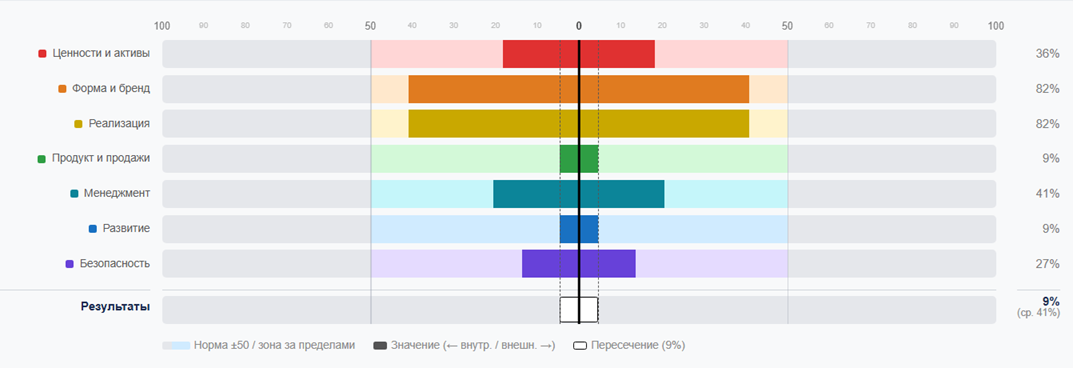 Values and assets — what the business is even built on: the idea, the positioning, the reason it has a right to exist. Mine sits at 36%, close to the norm, but not centered.
Form and brand — how it looks and feels from the outside. Mine is at 82% — overdeveloped, taking more attention than it needs at this stage.
Execution — how the product actually gets made and brought to completion. Also 82% — the same overspend as with brand.
Product and sales — whether it actually turns into money. Mine is at just 9% — the tightest bottleneck in the whole system.
Management — running the process day to day. 41%, close to the norm.
Growth — training, development, long-term investment in the future. 9% — also a weak spot.
Security — stability, compliance, risk protection. 27%, slightly below norm.
Once this is visible in a single snapshot, it becomes clear not "what else could I find," but exactly where to direct attention and resources. In my case, that is not real estate, not brand — it is product and sales, because that is where the gap is widest.
The same goes for you: if land or a building came up as priority number one in conversation, that is often not the real bottleneck in the system — just the part that is most visible. The real bottleneck only becomes visible once you look at the whole system at once, not one piece of it.
Free support
I do this kind of system snapshot myself, for free, on a 30-minute call. Not research, not a funnel — a live conversation, after which you will leave with clarity on where the overspend is, where attention is missing, and where to look for resources first.
[Block: Book a free session]